 Beethoven x
 separates stS unstaking from the final S withdrawal
Last updated -
Beethoven x, now Beets, converts an unstaking request for its Sonic liquid staking token, stS, into a pending S withdrawal. The documented process includes a 14-day unbonding period and a separate claim transaction. Requesting unstaking commits the selected tokens before that final withdrawal, so the waiting period is not a cancellation window.
Keep the exit changeable before submitting unstaking
If you need to preserve the option of keeping your stS, review the proposed unstaking amount before authorizing the transaction. Begin with stS available in your wallet. A balance inside a liquidity position first requires that position’s own exit process.
Use these conditions to decide whether to proceed:
- If you might need the selected stS during unbonding, leave the request unsubmitted.
- If the proposed amount exceeds what you intend to redeem, correct it before authorizing.
- If you cannot accept a delayed S withdrawal, compare the available swap quote before committing.
- If a submitted transaction has an unclear status, inspect its receipt before sending another request.
A successfully executed unstaking request burns the selected stS and creates a withdrawal claim. At that point, stop treating those tokens as an available wallet balance. Preserve the request details for the later claim. Completion comes when the eligible withdrawal succeeds and transfers S to the requesting account.
Can an stS unstaking request be cancelled?
The published stS contract has no user cancellation function for an executed unstaking request. The commitment happens when the request succeeds, rather than when you eventually claim S.
Before submission, changing an amount or abandoning the transaction preserves that choice. After execution, closing the interface does not restore the burned tokens. Buying or minting stS later would create a new position, with its own terms. It would not reverse the original request.
When does the pending S become withdrawable?
S becomes eligible for withdrawal after the applicable delay has elapsed, provided the withdrawal also satisfies the contract’s other checks. The documented unstaking process specifies 14 days, followed by a separate transaction to claim S.
That duration is configurable. Administrators can change the withdrawal delay, so a calendar reminder alone does not establish eligibility. The contract checks whether the request timestamp plus its current withdrawDelay setting has passed. A request becoming eligible also does not trigger an automatic wallet transfer.
The redemption amount can differ from the stS balance
stS represents a share of the underlying staking assets. Rewards added to those assets affect the conversion between stS and S. Consequently, the number of stS tokens selected for unstaking does not necessarily equal the number of S represented by the request.
Once unstaking burns those shares, the pending claim no longer participates in subsequent stS reward growth. Compare the eventual payment with the request’s amount, rather than a later stS conversion estimate. Validator slashing can affect the amount actually returned.
Pool redemption and validator redemption
The staking contract supports redemption from its undelegated S pool and redemption from a validator. The pool route requires enough available assets. It still creates a delayed withdrawal, even though those assets already sit in the staking contract.
This staking pool is separate from a trading liquidity pool. A market swap exchanges tokens with available trading liquidity. Pool-based unstaking instead follows the redemption process, including its waiting period and later withdrawal.
Match the claim to its completion record
A request identifier distinguishes one pending withdrawal from another. Its record includes the requesting account, asset amount, timestamp and processing status. Retaining the transaction receipt helps distinguish an executed request from an interface that has not refreshed.
A successful withdrawal marks its request as processed. The withdrawal transaction also records the amount paid. A countdown reaching zero proves neither of those outcomes.
Why can an eligible withdrawal still fail?
An elapsed waiting period does not override a withdrawal pause, an authorization failure or a request that has already been processed. These conditions require different responses.
A protocol pause needs the authorized administrator to restore withdrawals. Repeated submissions cannot remove it. An account mismatch requires the account associated with the request. An already completed request requires reconciliation with its payment, rather than another attempt to claim it. Keep the original request details while identifying the failed condition.
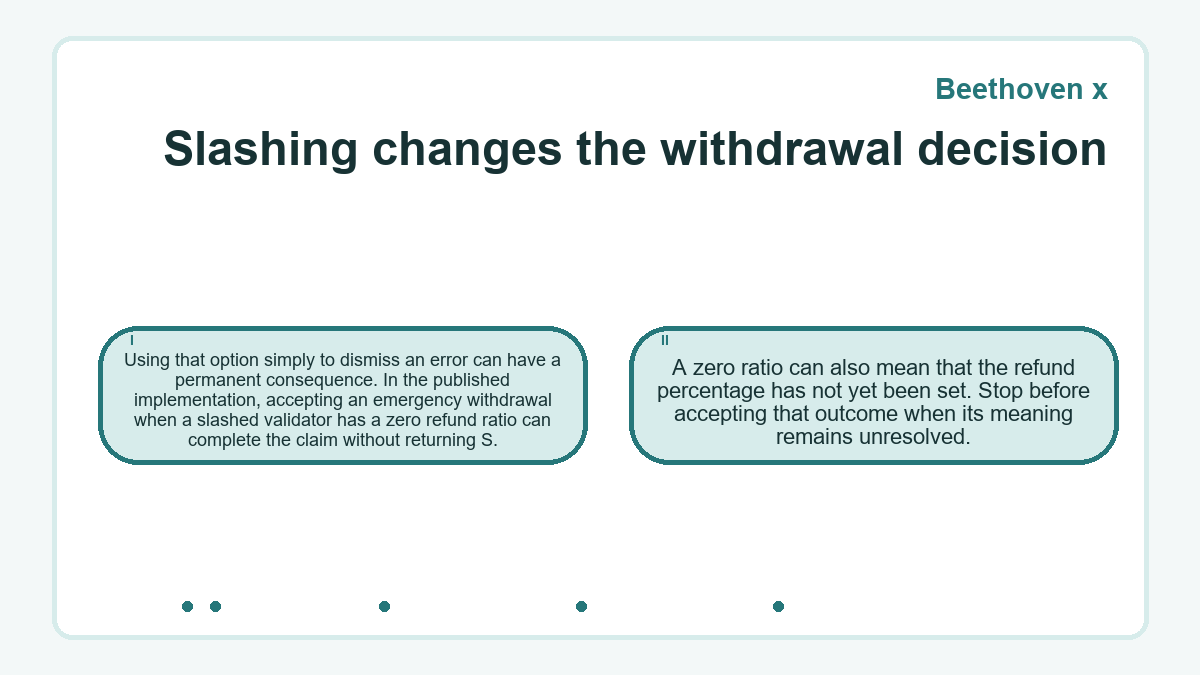
Slashing changes the withdrawal decision
A validator penalty can reduce the S available from a validator-backed request. The emergency withdrawal option acknowledges that loss; it does not provide a general shortcut around unbonding.
Using that option simply to dismiss an error can have a permanent consequence. In the published implementation, accepting an emergency withdrawal when a slashed validator has a zero refund ratio can complete the claim without returning S. A zero ratio can also mean that the refund percentage has not yet been set. Stop before accepting that outcome when its meaning remains unresolved.
Swapping offers a different exit before commitment
Swapping available stS for S can avoid the unstaking wait when sufficient trading liquidity exists. The exchange rate follows the available market quote, which may be less favorable than redemption through unstaking.
This alternative applies while you still hold transferable stS. It does not make an existing withdrawal claim tradeable or restore tokens that the unstaking request burned. If immediate access matters, compare the swap output before requesting unstaking. Once you commit to redemption, the remaining task is to complete the eligible S withdrawal.
Frequently asked questions
Can I unstake only part of my stS balance?
You can request unstaking for a selected amount rather than your entire stS balance. The amount must satisfy the contract’s minimum and the available assets for the chosen redemption route. Tokens outside the successful request remain separate from that withdrawal.
Does closing the browser interrupt the unbonding period?
Closing the browser does not interrupt an executed unstaking request. The contract stores its timestamp and status on the blockchain. Reopening the interface does not restart that timestamp, although you still need to submit the later withdrawal transaction.
Are staking reward fees another deduction from the requested principal?
No. The documented staking fees apply to rewards, not as another deduction from the requested principal. Reward deductions affect the assets backing stS before redemption. Keep those deductions separate from transaction costs and any validator slashing that affects the withdrawal.