 Beethoven x
 liquidity pools and losses after price shifts
Last updated -
Beethoven x liquidity pools can leave providers with less value than holding the deposited assets because swaps change the pool’s token balances. When relative prices move, arbitrage trades remove the comparatively underpriced asset and add the other asset. The resulting shortfall against holding is impermanent loss. A falling portfolio display alone does not establish that this mechanism caused the loss.
The distinction matters when a position shows fewer tokens, a lower valuation or an unexpected withdrawal amount. These symptoms can have overlapping causes. Pool composition, transaction completion and the comparison period determine whether the apparent shortfall represents an economic loss.
A missing valuation differs from an incomplete withdrawal
A blank or sharply reduced currency value can reflect missing price data while the underlying pool position remains unchanged. Portfolio screens depend on data services that can lag or fail. The token balance and its displayed currency conversion answer different questions.
The position exists but its price is missing
Balancer Pool Tokens, abbreviated BPT, represent a share of pool liquidity. Their quantity does not directly state the quantity of every underlying asset. A position can retain the same BPT balance while its composition and market value change. Staked BPT can also appear separately from the wallet’s freely held balance.
The withdrawal has no completed transfer
An approval grants spending permission; it does not itself withdraw liquidity. A pending withdrawal also provides no evidence that the receiving wallet has obtained the assets. A successful transaction, its token transfers and the resulting position balance establish the relevant state.
Until those records agree, repeating a withdrawal risks addressing the wrong problem. A completed transfer with an outdated display calls for a data refresh. An unresolved transaction status calls for checking that transaction before submitting another consequential action.
The loss comparison starts with the deposited assets
Impermanent loss compares pool ownership with holding the same starting assets over the same period. Comparing today’s pool value only with the deposit’s original currency value measures a different result.
The holding benchmark keeps the original token quantities unchanged and values them at the comparison time. The pool side uses the underlying assets attributable to the position at that same time. Both sides need consistent prices and units; mixing yesterday’s token prices with today’s pool balances creates a misleading difference.
A pool can rise in currency value while underperforming that holding benchmark. It can also fall in value mainly because its assets fell together. Neither outcome follows from the portfolio percentage alone.
The term describes a relative shortfall, not a guaranteed repayment later. For a fixed-weight pool, relative prices returning to their starting relationship can reverse the theoretical divergence component. That statement assumes the same position and excludes fees, additional cash flows and other losses.
Arbitrage changes the assets behind each pool token
A weighted pool calculates exchange prices from token balances and configured weights. When its quote differs sufficiently from outside markets, a trader can buy the cheaper asset from the pool and sell it elsewhere. Those trades change the reserves until the opportunity narrows.
A weighted pool’s spot price depends on the relevant token balances normalized by their weights. Consequently, holding BPT does not preserve the original quantity of each deposited token. As one asset appreciates relative to another, trades generally reduce the quantity of that outperforming asset held by the pool. The pool receives more of the comparatively weaker asset in exchange.
Unequal weights change exposure rather than preserve principal
A heavily weighted asset contributes more to a weighted pool’s value and price exposure. The weights also change how reserve balances respond to relative price movements. An unequal allocation therefore produces a different loss profile from an equal allocation. It does not protect the deposited currency value or remove exposure to a failing constituent. A fixed-weight calculation also cannot describe a pool whose weights change over time.
Fees and incentives belong in separate return components
Swap fees can offset divergence losses, but their contribution depends on actual trading activity and the portion retained for liquidity providers. The fee that the pool charges varies with its configuration. A displayed annualized return cannot establish how much a particular position earned during its holding period.
Beets reinvests liquidity providers’ swap-fee earnings within the pool. Those earnings already contribute to the position’s value, so adding them again would overstate returns. Separate staking incentives require separate accounting, including their token value at the chosen comparison time. Eligibility for those incentives depends on the pool and staking arrangement.
For net performance, transaction costs and any additional conversion costs also matter. These expenses reduce the amount ultimately retained, although they are not themselves impermanent loss. Keeping them separate makes the cause of underperformance easier to identify.
Stable pools depend on the relationship between their assets
Stable pool mathematics supports assets expected to trade near parity or an adjusted exchange relationship. Low price impact near that relationship does not establish that every constituent will maintain its value.
A broken peg changes the reserve mix
A stable pool can accumulate a depegging asset as traders exchange it for stronger constituents. A larger balance of the weakened token can accompany a smaller total position value. The relevant question becomes whether that asset retains a credible redemption or market value, rather than whether its token count increased.
Yield changes the expected exchange relationship
Some pools contain assets whose redemption value changes through an underlying yield mechanism. A rate provider can supply that conversion relationship to the pool’s calculations. Equal raw token quantities are therefore not always the appropriate comparison. The underlying asset value gives the useful common unit.
A rate dependency can distort the calculation
A rate provider supplies a contract-readable exchange rate. Its accuracy and availability matter wherever the pool uses that rate. A failed dependency or incorrect rate requires a different diagnosis from ordinary price divergence. An external lending or staking mechanism can also introduce losses beyond the pool’s trading activity.
Withdrawal composition can introduce an additional shortfall
A proportional withdrawal returns the position’s share of the pool’s existing asset mix. A withdrawal into a single asset changes that composition and can introduce conversion costs. The available operation depends on the pool version, its implementation and its state.
In standard Balancer V3 liquidity removal, a proportional exit has no price impact from changing reserve proportions. It also avoids the swap fee associated with a non-proportional exit. That property does not restore the original deposit mix or eliminate network costs. Single-asset removal instead depends on the pool’s pricing mathematics and available balances.
This separates losses that accumulated during ownership from costs introduced when leaving. Comparing a single-asset withdrawal quote with an earlier multi-asset valuation without accounting for the conversion combines both effects. Minimum-output protection constrains execution; it cannot recover value already lost before the withdrawal.
Recovery depends on the cause rather than elapsed time
Waiting does not provide a fixed deadline for recovering an impermanent loss. Relative prices might return, diverge further or remain apart. Fees might offset the difference, but their future accumulation depends on continued trading.
Changing pool weights, concentrated liquidity boundaries and external yield mechanisms can make a simple fixed-weight model inappropriate. A price returning to its earlier level does not establish that every such position returns to its earlier relative value. The pool’s actual rules determine which parts of that reasoning apply.
Exiting realizes the assets available under the withdrawal terms at that point. Re-entering creates a new position with new starting quantities. It does not reverse the earlier economic result, even if a portfolio application starts displaying a fresh performance history.
Contract incidents require a separate diagnosis
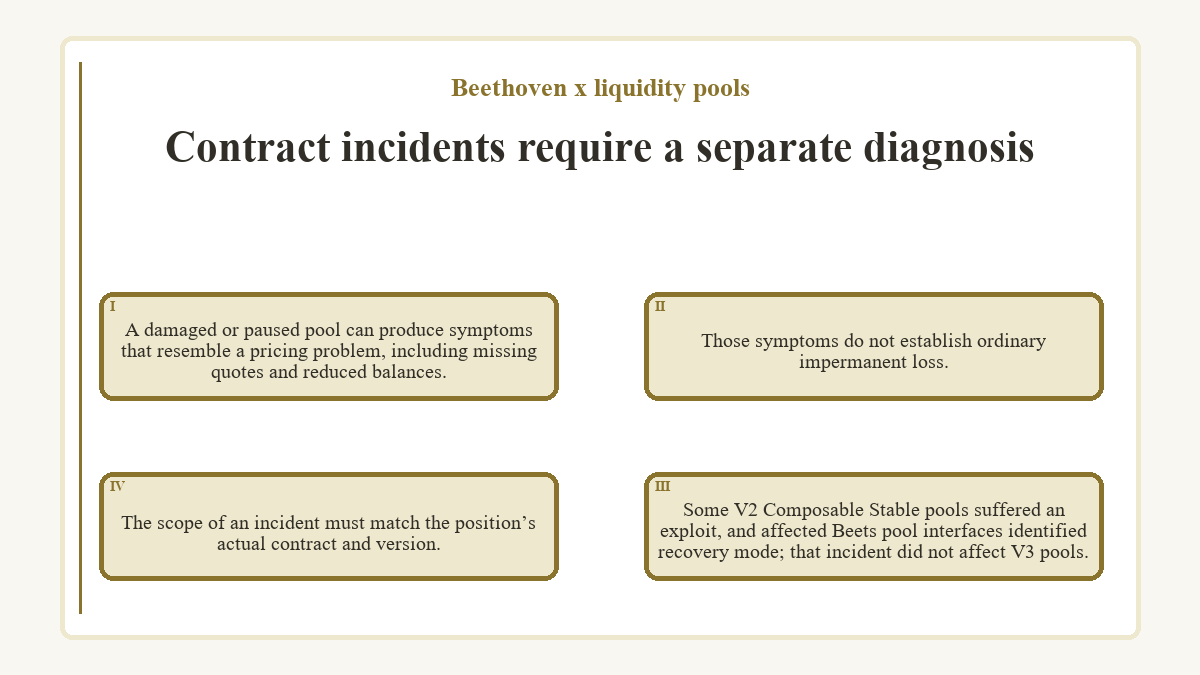
A damaged or paused pool can produce symptoms that resemble a pricing problem, including missing quotes and reduced balances. Those symptoms do not establish ordinary impermanent loss. Some V2 Composable Stable pools suffered an exploit, and affected Beets pool interfaces identified recovery mode; that incident did not affect V3 pools. The scope of an incident must match the position’s actual contract and version.
A visible withdrawal control does not establish that normal withdrawal remains executable. Recovery permissions and remaining reserves determine the available outcome. Repeated retries cannot replenish missing assets or repair a failed rate dependency.
The records needed before changing the position
A useful loss assessment has a confirmed position balance, an identified pool contract and version, matching valuation times and the original deposit quantities. It also distinguishes freely held BPT from staked holdings and accounts for any later deposits or withdrawals. Withdrawal receipts establish completed transfers; quotes describe proposed transfers.
If the records confirm only a display mismatch, refresh the data; the pool’s composition and value can still change while the display is stale. A completed valuation showing relative underperformance raises a choice about continued exposure or an available exit. Before signing, the expected asset mix and minimum outputs must match that choice. A completed transaction then requires matching receipt amounts and the remaining position balance, rather than a refreshed portfolio percentage alone.
Beethoven x liquidity pools: reader questions
Does another provider withdrawing liquidity automatically reduce the value of my share?
An ordinary proportional withdrawal reduces pool reserves and outstanding pool tokens together, so it does not automatically reduce the underlying assets attributable to your existing share. It can leave less liquidity available for later trading. Non-proportional withdrawals can also affect reserve composition through their pricing and fee mechanics.
Can a loss calculator use only the pool’s current weights?
Current weights alone are insufficient when the pool changed weights during the measurement period. A calculation also needs the relevant starting allocation and a model that matches the pool’s rules. Applying a fixed-weight formula to a changing-weight position can misstate the difference between providing liquidity and holding.
Why does adding more liquidity make my displayed loss percentage change?
An additional deposit changes the capital base and may change the application’s performance baseline. The new deposit enters at the asset mix and price relationship prevailing at that time, which may differ from the earlier deposit. Accurate performance accounting separates the added capital from investment gains or losses instead of treating the entire balance increase as earnings.
Is a larger pool automatically less exposed to impermanent loss?
A larger reserve does not automatically reduce impermanent loss for the same pool design and relative price movement. Depth primarily changes how strongly a particular trade affects the pool’s price. Divergence loss instead reflects the relationship between the changing asset prices, pool composition and applicable pricing mathematics.
Do I need to withdraw liquidity to measure its loss against holding?
You can estimate relative performance without withdrawing by valuing the position’s attributable underlying assets and the original deposit quantities at the same time, provided the balances and prices are reliable; an executable exit can differ because of conversion costs, transaction costs and changes before confirmation.
Which deposit record should a transferred pool position use?
A transferred position needs the acquisition basis relevant to the person measuring its performance. The recipient’s transfer record does not necessarily reveal the original underlying deposit quantities. Measuring personal performance since acquisition and measuring the transferred position’s divergence since the deposits that created it answer different questions.
When does a small token-balance discrepancy come from rounding?
Rounding can explain small differences because token amounts and contract calculations use finite precision. A discrepancy must fit the token’s decimals and the operation’s rounding rules before that explanation is credible. A material shortfall still requires reconciliation with the transaction transfers, fees and actual pool balances.